
Introduction Of Atmosphere:
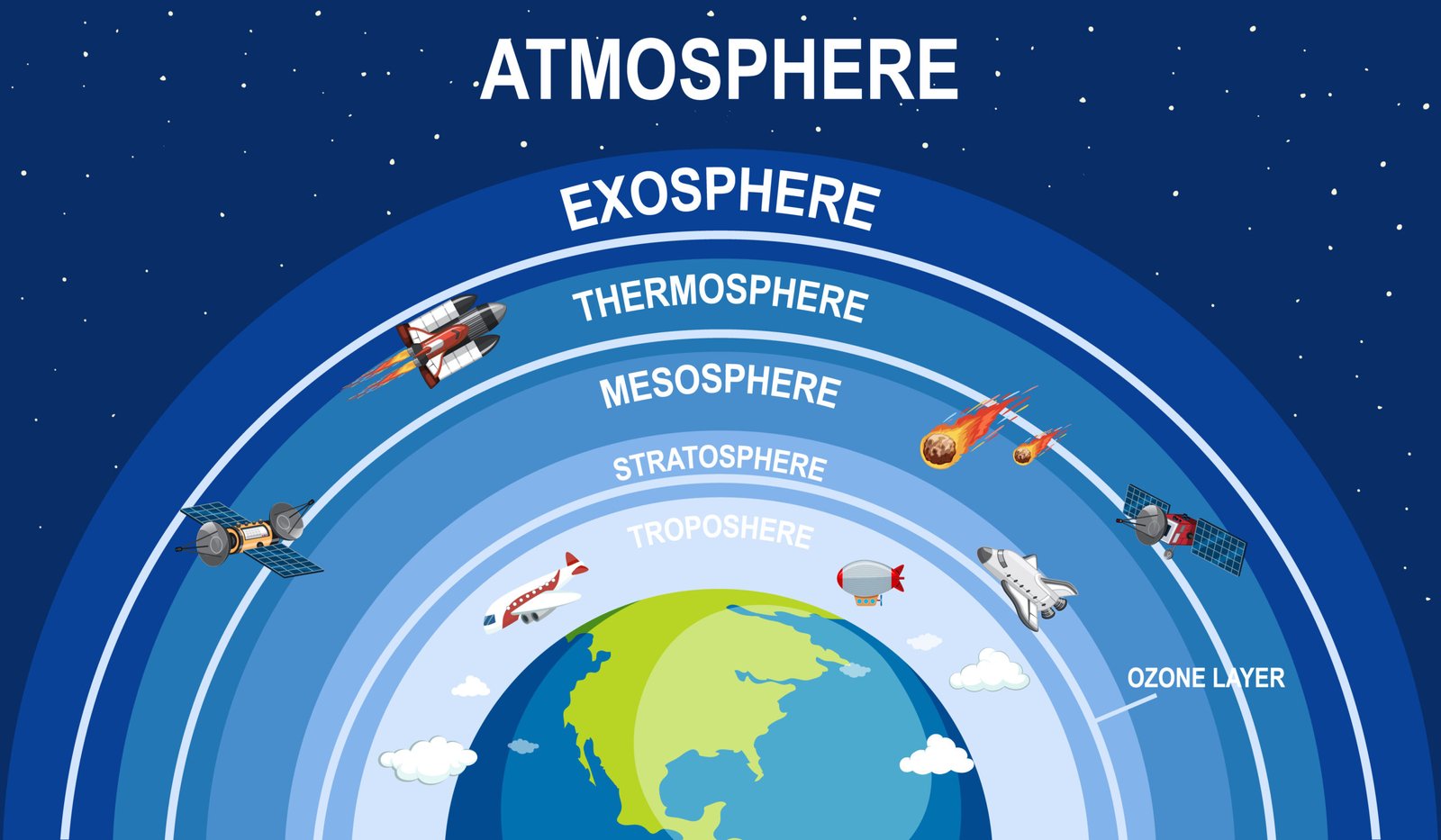
The Earth’s atmosphere acts as a blanket that protects us from harmful incoming radiation and helps keep the Earth’s temperature nearly constant.
Layers Of The Earth’s Atmosphere:
- Troposphere
- Stratosphere
- Mesosphere
- Thermosphere
- Exosphere
Troposphere (First Layer Of Earth’s Atmosphere):
Meaning Of Troposphere:
Tropos means change.
Introduction To Troposphere:
– The troposphere is closest to the Earth’s surface.
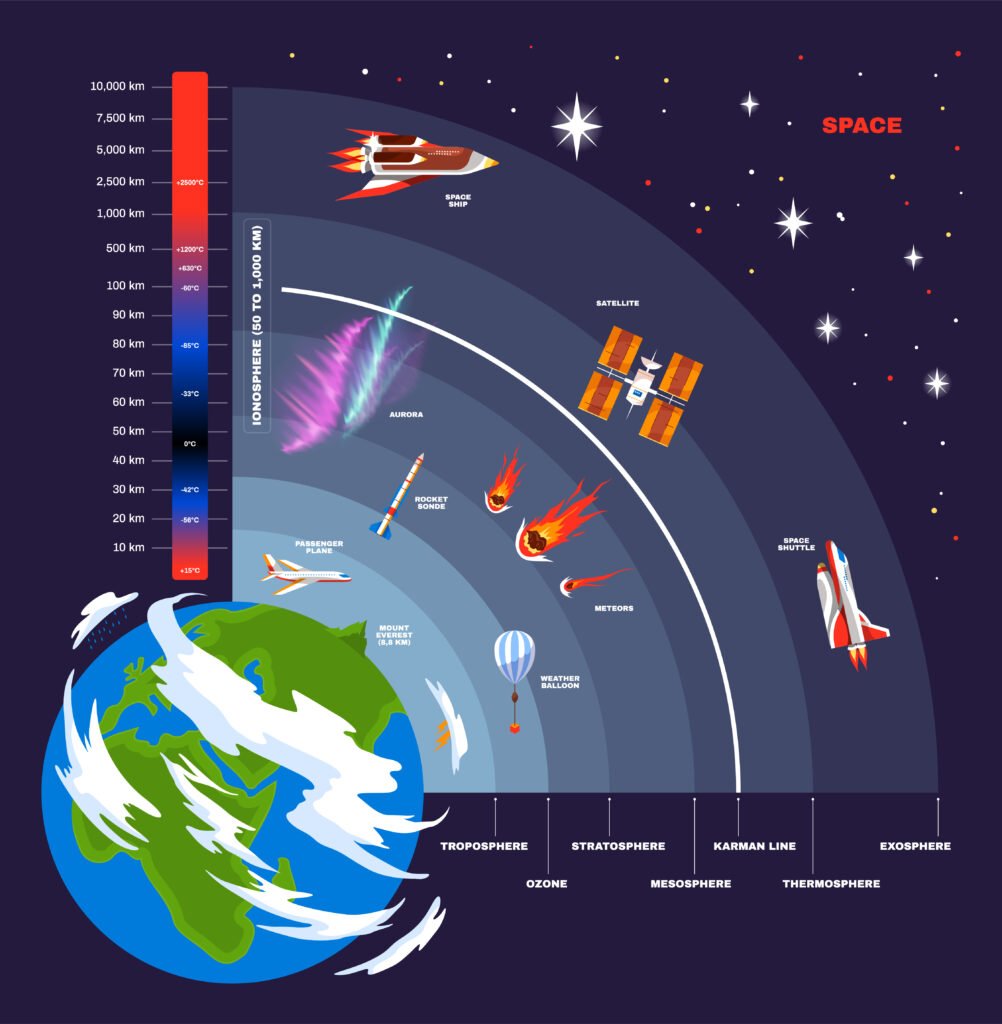
– It extends from the ground to 15 km high.
– The troposphere contains 75% of all the air and 99% of the water vapors that take part in the condensation and precipitation.
– In this layer, the weather is continuously fluctuating.
– The hot air balloons fly in the troposphere.
– The upper layer of the troposphere is known as the Tropopause.
– The tropopause is the layer where the airplanes fly.
– The thickness of this layer varies with the latitude and is maximum at the equator.
Stratosphere (Second Layer Of Earth’s Atmosphere):
Meaning Of Stratosphere:
Strat means layer.
Introduction To the Stratosphere:
– The stratosphere layer extends from the tropopause to about 50 km above the Earth’s surface.
– The stratosphere contains a thin layer of Ozone (O3), which protects from the UV radiation by absorbing the harmful radiation.
– Temperature increases here with height.
– There’s no vertical convection; the layer is stable.
– The high-altitude weather monitoring aircraft fly in the stratosphere.
Mesosphere (Third Layer Of Earth’s Atmosphere):
Meaning Of Mesosphere:
Meso means middle.
Introduction To the Mesosphere:
– The middle layer of the atmosphere is located above the stratosphere and beneath the thermosphere.
– The boundary that separates the stratosphere from the mesosphere is known as the Stratopause.
– It extends from the stratopause to 85 km above the Earth’s surface.
– Fewer air molecules absorb the incoming E.M radiation from the Sun.
– It is the coldest layer of the atmosphere.
– Most of the meteors burn here due to friction.
– The temperature decreases with an increase in height.
– Despite the thin air, the meteors are burnt due to friction.
Thermosphere (Fourth Layer Of Earth’s Atmosphere):
Meaning Of Thermosphere:
Therm means heat.
Introduction To the Thermosphere:
– The temperature in the thermosphere is extremely high.
– The thermosphere is located above the mesosphere and below the exosphere.
– The boundary layer that separates the Thermosphere from the Mesosphere is known as the Mesopause.
– The thermosphere extends from the mesopause to 700 km above the Earth’s surface.
– The thermosphere is the thickest layer of the atmosphere.
– The lightest gases, such as Oxygen, Helium, and Hydrogen, reside here.
– The Aurora and the satellites mostly occur in the Thermosphere.
– Auroras occur here due to solar wind interaction.
– The thermosphere contains the Ionosphere, which reflects the radio waves.
– The density of air is very low.
Exosphere (Fifth Layer Of Earth’s Atmosphere):
Meaning Of Exosphere:
Exo means outside.
Introduction To the Exosphere:
– The exosphere is the outermost layer of the Earth’s atmosphere.
– It extends from the thermosphere to 10,000 km above the Earth’s surface.
– Only higher altitude satellites orbit our planet in this layer.
– This layer merges with the outer atmosphere, and the atoms and molecules escape into space.
– The exosphere is mainly composed of Helium and Hydrogen gases.
Related Other Blog:
Earth An Interconnected Ecosystem